Aviator's dual-bet feature balances risk by pairing an early auto cash-out cushion with a high-multiplier target. While managing volatility, it doubles round exposure without altering the 97% RTP or Provably Fair house edge.
Quick Summary Answer: Operating two simultaneous betting panels in Spribe's Aviator allows players to structure multi-layered risk strategies—such as setting Panel A to auto cash-out early (e.g., 1.30x–1.50x) to cushion the total round stake while leaving Panel B active to target higher multiplier curves. However, utilizing dual bets doubles your combined financial exposure per round and never alters the underlying 97% Return to Player (RTP) or server-side Provably Fair house edge. Automated execution and rigid stop-loss discipline are mandatory to prevent visual pressure from triggering premature manual overrides.
Strategic Overview: Dual-Panel Stake & Volatility Allocation
To evaluate how dual-panel betting balances risk across active flight curves, consider the standard 70/30 Stake Split Allocation Model:
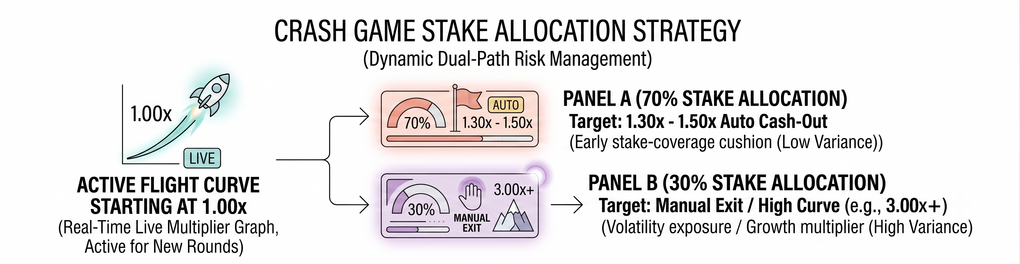
Placing two bets simultaneously divides your round strategy into two distinct operational roles. Panel A acts as a safety anchor to offset the initial outlay, while Panel B remains exposed to short-term variance in pursuit of scaling payouts.
Product Experience Highlights: Navigation, Touch Response, and Dual Timers
When managing two bets at once in Spribe's Aviator, smooth platform mechanics and low execution latency are essential to keeping your strategy on track:
Dual-Panel Interface Navigation: The game interface features two identical, independent betting controls side by side. Each panel allows you to configure manual bets, distinct Auto Bet amounts, and separate Auto Cash-Out parameters without interfering with the other.
Quick Touch Response & Latency: In a game where multiplier curves scale within split seconds, tactile UI responsiveness is critical. A delayed tap during manual cash-out can mean the difference between locking in a low-multiplier safety net and crashing out.
Synchronized Dual Auto Cash-Out: To remove manual reaction lag under pressure, both panels support automated exit limits. You can set Panel A to auto cash-out at a low target (e.g., 1.30x–1.50x) while setting Panel B to target a higher multiplier curve.
The Dual-Panel Player Experience Path
Executing a two-panel strategy under real-time conditions follows three core operational phases:
Observation Stage: The player audits both betting panels, setting up the exact stake amounts for Panel A and Panel B and verifying that both automated cash-out triggers are configured correctly before joining the active round.
Adaptation Stage: The player observes the flight curve, assessing how the low-multiplier target (Panel A) clears early to cover total round stakes, while the second panel (Panel B) continues scaling along the visual multiplier line.
Decision Stage: The player evaluates short-term session swings, deciding whether to maintain fixed exposure rules or exit the session if rapid resets trigger emotional stake escalation.
Operational Insight: If you find yourself manually adjusting the second panel's cash-out target mid-flight after Panel A succeeds, this is precisely where split-second visual pressure overrides pre-planned discipline.
Psychological Attractors & Common Misconceptions
Mastering the Spribe Aviator double bet feature strategy requires separating structural control options from psychological traps.
Common Misconceptions
Misconception 1: "The Safety Bet Guarantees Profit Every Round" — Cashing out Panel A at 1.50x covers a portion of your combined stake, but an instant crash (e.g., 1.00x) results in losing both stakes simultaneously.
Misconception 2: "Two Bets Give You Control Over Game RNG" — Splitting your exposure across two panels changes your risk profile and payout cadence, but every round remains dictated by an independent, server-side Provably Fair algorithm.
Psychological Attractors
The "Free Roll" Illusion: Securing a quick exit on Panel A often creates a false sense of security, tempting players to hold Panel B far too long in pursuit of unrealistic multipliers.
Rapid Round Resets: The brief intervals between rounds leave little time to review overall session balance, encouraging immediate re-engagement before assessing variance.
Core Game Mechanics: The Reality of Multi-Panel Probability
When applying a Spribe Aviator double bet feature strategy, keep these fundamental probability rules anchored in your mind:
Cryptographic Round Independence: Each round is generated using independent cryptographic seeds via Provably Fair technology. Outcomes from previous rounds have zero impact on upcoming flight durations.
Combined Variance Exposure: Placing two bets increases your total financial exposure per round. While dual cash-out options offer flexibility, they do not reduce the statistical house edge over long-term play.
Server-Side Execution: Outcome logic is computed on remote servers before the round starts. Touch lag or UI animations only delay visual feedback, not the calculated result.
Is This Strategy Right for You?
Who It Suits
Structured, Tactical Players: Users who systematically utilize dual Auto Cash-Out settings to maintain strict execution discipline.
Risk-Conscious Evaluators: Individuals who split their budget to cushion session volatility rather than pursue single high-risk outcomes.
Experienced Operators: Players familiar with the platform interface who can manage multi-panel setups without making accidental UI errors.
Who It Does Not Suit
Impulsive Decision-Makers: Players prone to manual panic adjustments during scaling multipliers.
Pattern Hunters: Anyone who believes dual-bet timing can predict or manipulate RNG crash behavior.
Income Seekers: Users treating two-panel betting as a reliable profit strategy rather than entertainment.
Actionable Decision Guide
Before deploying both panels in live sessions, follow this structured framework:
How to Start: Test the dual interface in demo mode first. Pre-set Panel A to an automated low cash-out (e.g., 1.30x–1.50x) and Panel B to a moderate target, ensuring automated execution is active on both sides.
How to Control: Calculate your multi-round exposure budget based on total stake across both panels. Never double your stakes on either panel to chase losses after an early crash.
When to Stop: Discontinue play immediately if connection lag interferes with touch response, if short-term variance prompts you to disable automated cash-outs, or if your session bankroll drops past your pre-set stop-loss boundary.